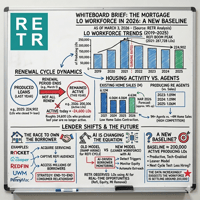
Market Movers Last week, 274 originators switched companies and 1,238 individuals obtained their...
Market Movers
Last week, 239 originators switched companies and 1,236 individuals obtained their NMLS license. Notable originator movements last week include:
- Deanna Holzinger ($160.1M, 456 units) joined West Capital Lending, Inc.
- Michael Schuster ($106.2M, 264 units) joined CrossCountry Mortgage, LLC
- Melissa Town ($78.4M, 123 units) joined THE TURNKEY FOUNDATION INC.
- Korbin Causey ($76.1M, 251 units) joined CrossCountry Mortgage, LLC
- Erika Worden ($75.9M, 168 units) joined HomeAmerican Mortgage Corporation
- Stewart Sadler ($72.8M, 157 units) joined Neighborhood Loans, Inc.
- Christopher Wright ($56.4M, 63 units) joined Finance of America Reverse LLC
- Hunter Nevotti ($53.2M, 135 units) joined Loan Peak Financial, LLC
- Max Dunevitz ($49.1M, 190 units) joined Liberty Financing LLC
- Michael Zamarripa ($47.8M, 59 units) joined Finance of America Reverse LLC
- Bradley Smith ($47.5M, 88 units) joined Fifth Third Bank, National Association
- Tahni Corrales ($46.8M, 225 units) joined Onity Mortgage Corporation
- James Kraft ($44.6M, 84 units) joined HomeAmerican Mortgage Corporation
- Christine Schmidt ($43.7M, 154 units) joined Lakeview Loan Servicing, LLC
Figures are based on last 14 months’ production.
Market Movers (Companies)
Top Gainers (non-Bank/CU):
- Amerifund Home Loans, Inc. +19.81%
- Loan Velocity, Inc. +19.42%
- Panorama Mortgage Group, LLC +4.61%
- HomeAmerican Mortgage Corporation +3.79%
- NextMortgage, LLC +3.44%
- Finance of America Reverse LLC +3.35%
- West Capital Lending, Inc. +2.95%
- Clear2Mortgage Inc. +2.87%
- Directions Home Loan +2.78%
- SUCCESS Lending, LLC +2.62%
- ARBOR Financial Group +2.41%
Calculations based on last aggregate production of individual LO’s 14 months’ production for companies with at least 20 loan officers. Excludes companies below $100M in 14mo LO production value after gains factored in.

The Search for Mortgage Opportunity Is Shifting Toward Home Equity
At the MBA Secondary and Capital Markets Conference in New York last week, one topic has consistently surfaced in conversations across the industry: where will mortgage loan opportunity come from if rates remain elevated?
That question has become even more urgent as interest rates have climbed again. The U.S. 30-year Treasury yield recently reached its highest level since 2007, while the 10-year Treasury yield climbed to its highest point in 16 months. For lenders and investors hoping for a broad rate-driven refinance cycle, the latest market movement has reinforced the idea that the industry may need to look elsewhere for growth.
Increasingly, many believe that opportunity sits in homeowner equity.
Back in February, we analyzed tappable equity across the U.S. mortgage market by examining non-VA loans with current loan-to-value ratios below 80% and calculating available equity up to the 80% threshold.
What surfaced was staggering:
- 41,171,278 loans
- $17.2 trillion in available tappable equity
At the time, it highlighted just how much housing wealth had accumulated on consumer balance sheets. But in today’s higher-rate environment, that equity is becoming strategically more important.
The latest loan type trends help explain why.
2023 Loan Mix
- Purchase: 62.1%
- Refinance: 26.2%
- Equity: 11.7%
2024 Loan Mix
- Purchase: 60.8%
- Refinance: 28.3%
- Equity: 10.9%
2025 Loan Mix
- Purchase: 54.7%
- Refinance: 33.6%
- Equity: 11.6%
2026 YTD Loan Mix
- Purchase: 46.7%
- Refinance: 42.3%
- Equity: 11.0%
The most immediate trend is the steady compression in purchase share. In just three years, purchase loans declined from more than 62% of total volume to less than 47% year-to-date in 2026.
At the same time, refinance activity has risen materially. But unlike prior refinance waves driven primarily by falling rates, much of today’s refinance activity appears tied to borrowers seeking liquidity, restructuring debt, or refinancing loans originated during the higher-rate environment of 2023 and 2024.
Importantly, this does not necessarily conflict with the growing industry focus on home equity lending. In many ways, both trends stem from the same underlying reality: homeowners are sitting on unprecedented levels of accumulated housing wealth while simultaneously facing affordability pressure, higher consumer debt balances, and tighter household budgets.
The result is that lenders are increasingly competing across multiple equity-access products:
- Cash-out refinances
- HELOCs
- Closed-end second liens
- Other home equity solutions
The borrower decision often comes down to one key variable: the rate on their existing first mortgage.
For homeowners sitting on ultra-low rates from 2020 and 2021, giving up that first lien can be difficult to justify, making second-lien products more attractive. Meanwhile, borrowers who originated at higher rates in 2023 or 2024 may have refinance incentive while also seeking to access equity at the same time.
That dynamic is reshaping how many lenders are thinking about growth opportunities moving forward.
The industry may no longer be waiting for one large macro refinance wave to restore production volumes. Instead, opportunity could become increasingly borrower-specific and equity-driven:
- Homeowners consolidating debt
- Consumers funding renovations
- Borrowers managing higher living costs
- Investors accessing accumulated housing wealth
- Aging homeowners leveraging equity strategically
The challenge now becomes operational as much as macroeconomic.
Which lenders can identify these borrowers first?
Who has the data infrastructure to surface equity opportunities before competitors?
How will originators educate homeowners who may not fully realize how much tappable equity they have accumulated?
As discussions continue at MBA Secondary and Capital Markets this week, one theme appears increasingly clear: in a higher-for-longer rate environment, housing wealth itself may become one of the mortgage industry’s most important growth channels.
Upcoming RETR Training
-
- No Intro to RETR Training this week - we'll be back next week. Happy Memorial Day!
- Wed, May 27 @ 1p ET Mastering List Building and Exporting Data in RETR Register
Is RETR Better?
When it comes to mortgage market intelligence, you have a handful of options, and RETR is one that truly stands out. Here’s what Debbie Haberny, top producer at Mission One Mortgage has to say about RETR: “RETR has truly been a game changer for my business! The platform provides real time, critical information on home sales, upcoming open houses, current rates, and market activity. Having access to this insight helps me stay ahead of trends and build stronger relationships with my partners and clients.”

But you don’t have to take their word for it. RETR offers a free trial to loan officers, branches, and mortgage companies to judge the quality of the data and insights for themselves.