

Market Movers
Last week, 568 originators switched companies and 1,531 individuals obtained their NMLS license. Notable originator movements last week include:
- Max Bottaro ($179.2M, 130 units) joined Rate
- Rachel Johnson ($104.8M, 282 units) joined NFM Lending, LLC
- Beth Bauman ($82.5M, 171 units) joined GRIFFIN FUNDING, INC.
- Kyle Englehart ($73.9M, 326 units) joined CrossCountry Mortgage, LLC
- Katherine Smith ($69.3M, 240 units) joined West Capital Lending, Inc.
- Brenda Dawson ($65.8M, 173 units) joined Oakdale Mortgage LLC
- Anthony Valentino ($63.8M, 80 units) joined NEXA Mortgage, LLC
- Jorge Becerra ($62.9M, 83 units) joined JPMorgan Chase Bank, National Association
- Brian Smith ($62.1M, 237 units) joined CrossCountry Mortgage, LLC
- Jeffrey Riekhof ($57.5M, 203 units) joined The Federal Savings Bank
- Susan Cassady ($56.1M, 152 units) joined First Federal Bank
- Slade Terry ($55.9M, 218 units) joined NFM Lending, LLC
- Daniel Beyer ($55.6M, 105 units) joined New American Funding, LLC
- Nicholas Carter ($55.5M, 166 units) joined CMG Mortgage, Inc.
- Brent Englehart ($54.2M, 279 units) joined CrossCountry Mortgage, LLC
- Miranda Lau ($53.7M, 170 units) joined HOMEROCK MORTGAGE INC
- Karalee Coughlin ($53.3M, 216 units) joined Truist Bank
- Clyde Anderson ($52.2M, 129 units) joined loanDepot
- Bradley Dexter ($51M, 177 units) joined Rate
- Na Hao ($49.4M, 27 units) joined U.S. Bank National Association
Figures are based on last 14 months’ production.
Market Movers (Gainers by Producer Volume)
Top Gainers (non-Bank/CU):
- Guaranteed Rate Affinity, LLC +77.93%
- GRIFFIN FUNDING, INC. +21.34%
- Van Dyk Mortgage Corporation +14.73%
- INTERSTATE HOME LOAN CENTER, INC. +8.14%
- Origna8 Mortgage LLC +5.77%
- Reliant Mortgage LLC +5.1%
- PATRIOT PACIFIC FINANCIAL CORP. +4.56%
- Federal First Lending LLC +4.26%
- Client Direct Mortgage +4.08%
- O C Home Loans Inc. +4.02%
- Rize +2.62%
- NEXA Mortgage, LLC +2.6%
- Direct Mortgage Loans, LLC +2.17%
- Spartan Lending LLC +2.01%
- Kind Lending, LLC +1.83%
Calculations based on last aggregate production of individual LO’s 14 months’ production. Excludes companies below $200M in 14mo LO production value after gains factored in.
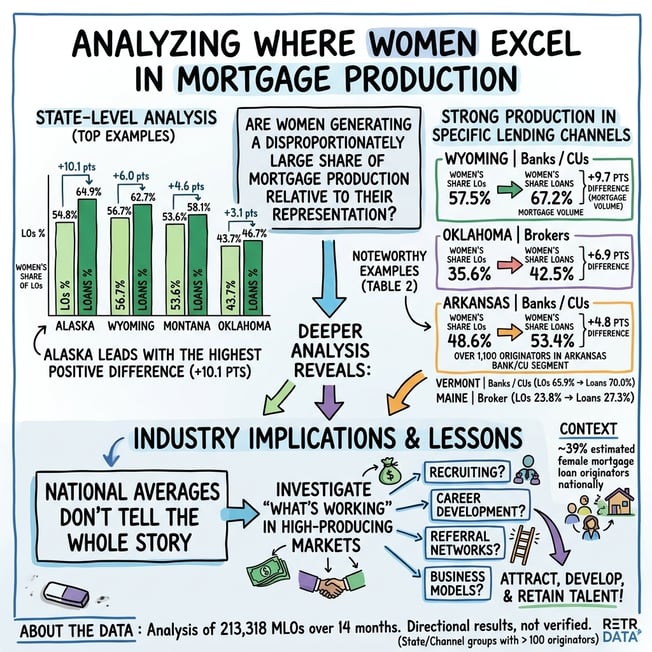
Where Are Women Excelling in Mortgage Production? States and Lending Channels That Stand Out
Women represent an estimated 39% of mortgage loan originators nationally. But in some markets, they're generating a larger share of mortgage production than their representation would suggest.
Over the past two weeks, RETR has examined women's representation across the mortgage industry and ranked all 50 states and Washington, D.C., by estimated female representation.
For Part 3, we wanted to explore a different question:
Where are women generating a disproportionately large share of mortgage production relative to their representation among loan originators?
Using our updated dataset of 213,318 originators, we compared women's estimated share of the workforce with their share of funded loans and mortgage volume over 14 months.
Here's what stood out.
Where Are Women Outperforming Their Representation?
Several states stood out where women-associated originators generated a greater share of funded loans than their share of the originating workforce.
|
State |
Women's Share of LOs |
Women's Share of Loans |
Difference |
|
Alaska |
54.8% |
64.9% |
+10.1 pts |
|
Wyoming |
56.7% |
62.7% |
+6.0 pts |
|
Montana |
53.6% |
58.1% |
+4.6 pts |
|
Oklahoma |
43.7% |
46.7% |
+3.1 pts |
|
Mississippi |
42.7% |
44.9% |
+2.2 pts |
|
Colorado |
37.9% |
39.6% |
+1.7 pts |
|
Arkansas |
47.8% |
49.2% |
+1.5 pts |
|
Minnesota |
35.5% |
36.7% |
+1.2 pts |
Alaska leads the way: Women represent an estimated 55% of originators but account for nearly 65% of funded loans.
Wyoming and Montana also stand out, with women generating a greater share of production than their estimated workforce representation.
These results become even more interesting when we examine individual lending channels.
Where Are Women Excelling Within Lending Channels?
Breaking the data down by state and company type reveals additional pockets of strong female production.
|
State |
Lending Channel |
Women's Share of LOs |
Women's Share of Loans |
|
Wyoming |
Bank / CU |
57.5% |
67.2% |
|
Oklahoma |
Broker |
35.6% |
42.5% |
|
Arkansas |
Bank / CU |
48.6% |
53.4% |
|
Oklahoma |
Bank / CU |
44.8% |
49.4% |
|
Mississippi |
Bank / CU |
43.0% |
47.3% |
|
Vermont |
Bank / CU |
65.9% |
70.0% |
|
Massachusetts |
Broker |
23.8% |
27.3% |
|
Texas |
Bank / CU |
41.4% |
44.9% |
|
New Hampshire |
Bank / CU |
63.1% |
66.1% |
|
Maryland |
Broker |
18.8% |
21.7% |
|
North Dakota |
Bank / CU |
55.9% |
58.7% |
|
Colorado |
IMB |
38.5% |
41.1% |
|
Nevada |
IMB |
38.7% |
41.1% |
Includes state and lending-channel combinations with at least 100 originators whose names supported a gender estimate.
Three findings are particularly noteworthy.
Wyoming banks and credit unions: Women represent 57.5% of originators but account for 67.2% of funded loans and 62.8% of mortgage volume.
Oklahoma mortgage brokers: Women represent just 35.6% of originators but generate 42.5% of funded loans and 38.0% of mortgage volume.
Arkansas banks and credit unions: Women represent 48.6% of originators but generate 53.4% of funded loans. This finding is particularly interesting because the segment includes more than 1,100 originators whose names supported a gender estimate.
What Can the Mortgage Industry Learn?
Our earlier research found that women's estimated representation generally declines among higher-producing originators.
But this deeper analysis reveals something important: The national averages don't tell the whole story.
In certain states and lending channels, women generate a disproportionately large share of mortgage production relative to their representation.
Why?
Could it be differences in recruiting, career development, referral networks, or the business models of lenders operating in these markets?
The data doesn't establish the causes, but it gives the industry an opportunity to investigate what's working.
Rather than focusing only on where women are underrepresented, perhaps we should also be learning from the markets where they're achieving particularly strong production results.
For mortgage companies looking to attract, develop, and retain talented originators, those lessons could be valuable.
Upcoming RETR Training
-
- Mon, Nov 16 @ 2p ET - Intro to RETR: The Modern Loan Officer’s Data Advantage Register
- Wed, Nov 18 @ 1p ET - Work Smarter in RETR: Lists, Exports & the Little Things That Save Hours Register
Is RETR Better?
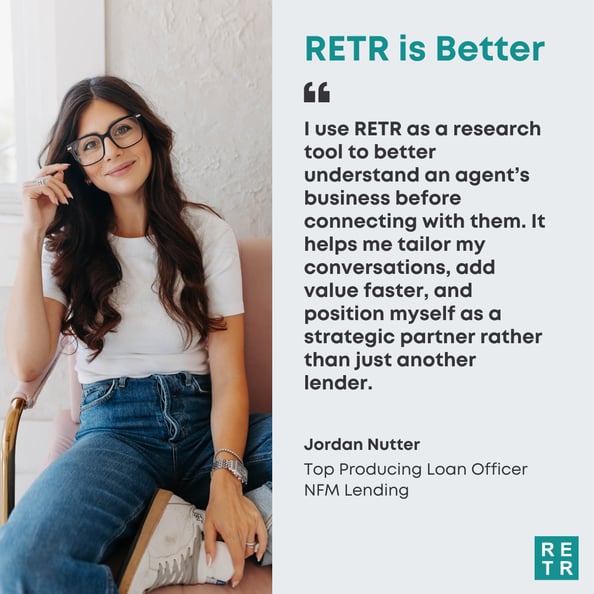
When it comes to mortgage market intelligence, you have a handful of options, and RETR is one that truly stands out. Here’s what Jordan Nutter, a top producer at NFM Lending has to say about RETR: “I use RETR as a research tool to better understand an agent’s business before connecting with them. It helps me tailor my conversations, add value faster, and position myself as a strategic partner rather than just another lender.”
But you don’t have to take their word for it. RETR offers a free trial to individuals and organizations to judge the quality of the data and insights for themselves.