

Market Movers
Last week, 302 originators switched companies and 1,136 individuals obtained their NMLS license. Notable originator movements last week include:
- Evan Roggio ($194.7M, 453 units) joined West Capital Lending, Inc.
- Jeanna Carey ($148.5M, 331 units) joined Movement Mortgage, LLC
- Daniel Arias ($145.2M, 145 units) joined OriginPoint LLC
- Elizabeth Song ($119M, 97 units) joined M&T Bank
- David Cline ($104.1M, 73 units) joined Guaranteed Rate, Inc.
- Thomas Sherman ($99M, 204 units) joined Guaranteed Rate, Inc.
- Michael Lindsay ($97.7M, 247 units) joined NEXA Mortgage, LLC
- Kevin Mitch ($70.4M, 216 units) joined Canopy Mortgage, LLC
- Louis Conte ($66.5M, 190 units) joined loanDepot.com, LLC
- Darren Kidder ($65.1M, 174 units) joined West Capital Lending, Inc.
- Ahmed Alhayom ($64.9M, 237 units) joined Liberty 1 Lending Inc.
- Matthew Gray ($63.4M, 139 units) joined Luminate Bank
- Daniel Langham ($57.3M, 198 units) joined Lower, LLC
- Will Ihloff ($56.2M, 74 units) joined CMG Mortgage, Inc.
- Brian Banks ($54.9M, 107 units) joined Finaya
- Evan Hall ($51.8M, 125 units) joined Hall Financial
- Kathryn Sonnen ($51.3M, 208 units) joined Lennar Mortgage, LLC
- Robby Baydoun ($51.1M, 155 units) joined Sonic Loans Inc.
- Brandon Burkhardt ($50M, 186 units) joined American Pacific Mortgage Corporation
Figures are based on last 14 months’ production.
Market Movers (Gainers by Producer Volume)
Top Gainers (non-Bank/CU):
- Lending Heights, LLC +13.13%
- Button Finance, Inc. +11.88%
- Reliant Mortgage LLC +10.39%
- Reliant Mortgage LLC +10.39%
- Lumin Lending Inc. +8.13%
- DYNAGEN LENDING, LLC +6.94%
- Luminate Bank +6.68%
- Quintessential Mortgage Group, LLC +6.52%
- Ladera Lending, Inc. +5.62%
- West Capital Lending, Inc. +4.07%
- Independent Mortgage Brokers LLC +3.93%
- Rize Mortgage +2.82%
- Kind Lending, LLC +2.75%
- United Direct Lending LLC +2.65%
- Absolute Home Mortgage Corporation +2.16%
- NEXA Mortgage, LLC +2.16%
- OCMBC, INC. +2.08%
Calculations based on last aggregate production of individual LO’s 14 months’ production. Excludes companies below $200M in 14mo LO production value after gains factored in.
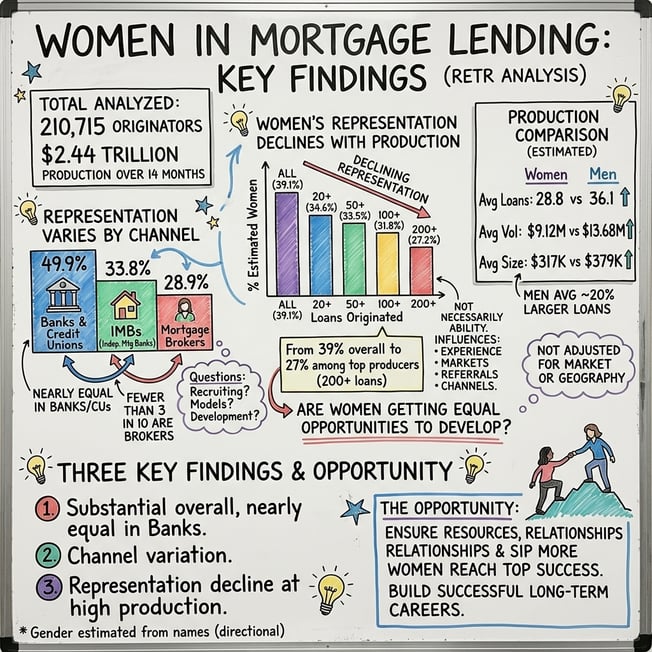
Women in Mortgage Lending: What 210,000 Loan Originators Reveal About Representation and Production
What percentage of mortgage loan originators are women, and how does their representation change among the industry's top producers?
RETR analyzed 210,715 mortgage loan originators representing approximately $2.44 trillion in mortgage production over 14 months to explore women's representation across the industry.
Because our data doesn't include gender, we made a best-effort estimate based on originators' first names.
Our findings suggest that approximately 39% of mortgage loan originators are women, based on the names for which we could make a reasonable estimate.
But the more interesting findings emerge when we look at lending channels and production levels.
Women's Representation Varies by Lending Channel
One of the most striking findings was the difference in estimated female representation across lending channels.
|
Lending Channel |
Estimated Women |
|
Banks and Credit Unions |
49.9% |
|
Independent Mortgage Banks |
33.8% |
|
Mortgage Brokers |
28.9% |
Banks and credit unions have nearly equal representation, while women appear to account for fewer than three in ten mortgage brokers.
This raises questions about how recruiting, compensation structures, career development, and business models influence women's participation across different segments of the industry.
Are Women Represented Among Top-Producing Loan Originators?
We also examined how representation changes as production increases.
|
Loans Originated in 14 Months |
Estimated Women |
|
All originators |
39.1% |
|
20 or more |
34.6% |
|
50 or more |
33.5% |
|
100 or more |
31.8% |
|
200 or more |
27.2% |
Women's estimated representation declines from 39% overall to 27% among originators who funded at least 200 loans.
This doesn't necessarily indicate differences in individual ability or potential. Experience, geographic markets, referral networks, and lending channels can all influence production.
However, it raises an important question: Are women receiving the same opportunities and support to develop into top-producing loan originators?
How Does Mortgage Production Compare?
Our analysis also revealed differences in average production among originators whose names could reasonably be associated with women or men.
|
Production Metric |
Estimated Women |
Estimated Men |
|
Average Loans Originated |
28.8 |
36.1 |
|
Median Loans Originated |
11 |
16 |
|
Average Origination Volume |
$9.12M |
$13.68M |
|
Average Loan Size |
$317K |
$379K |
The difference in average loan size is particularly noteworthy. Originators with men-associated names averaged approximately 20% larger loans.
Because mortgage volume is influenced by property values and geography, differences in loan size may explain some of the variation in total production. These figures have not been adjusted for market, experience, or lending channel.
The Opportunity for Women in Mortgage Lending
Three findings stand out:
- Women represent a substantial portion of the industry, with nearly equal estimated representation at banks and credit unions.
- Representation varies considerably by lending channel, particularly among mortgage brokers.
- Women's representation declines at higher production levels, raising questions about access to mentorship, referral networks, and career development opportunities.
Women already contribute hundreds of billions of dollars in mortgage production. The opportunity for lenders is not simply to recruit more women, but to ensure talented originators have the resources, relationships, and support needed to build successful, long-term careers.
The question isn't just how many women work in mortgage lending. It's how the industry can help more women reach the highest levels of success.
About the Data: RETR analyzed 210,715 originators and approximately $2.44 trillion in production over 14 months. Gender was estimated using first-name conventions, with reasonable estimates possible for approximately 74% of records. Findings are directional, not verified gender statistics. Production comparisons are descriptive and are not adjusted for geography or experience.
Upcoming RETR Training
-
- Mon, Nov 2 @ 2p ET - Intro to RETR: The Modern Loan Officer’s Data Advantage Register
- Mon, Nov 2 @ 2p ET - Intro to RETR: The Modern Loan Officer’s Data Advantage Register
Is RETR Better?
When it comes to mortgage market intelligence, you have a handful of options, and RETR is one that truly stands out. Here’s what Kaitlyn Linane, a top producer at Guild Mortgage has to say about RETR: “RETR has changed the way I build my business in the best way. Instead of trying to work with everyone, I’m now intentionally partnering with fewer agents and closing more business. The platform gives me clear insight into which agents are truly producing and what types of loans they’re referring, so I can align my company’s strengths and focus on the partnerships that make the most impact. That level of visibility has helped me attract the right relationships, serve more clients effectively, and operate from a place of strategy not hustle. If you’re a loan officer looking to scale with purpose and efficiency, RETR is a no-brainer.”

But you don’t have to take their word for it. RETR offers a free trial to individuals and organizations to judge the quality of the data and insights for themselves.