

Market Movers
Last week, 226 originators switched companies and 1,017 individuals obtained their NMLS license. Notable originator movements last week include:
- William Stern ($172.5M, 302 units) joined Volt Home Loans, LLC
- Ravichandra Sriram ($78.6M, 117 units) joined SI Mortgage Company
- Terry Whitesell ($76.6M, 288 units) joined Fairway Independent Mortgage Corporation
- William Luper ($66.3M, 264 units) joined Movement Mortgage, LLC
- Paul Vincent ($58.2M, 143 units) joined Union Home Mortgage Corp.
- Dean Miller ($57M, 55 units) joined NBH Bank
- Lisa Shaull ($53M, 87 units) joined NEXA Mortgage, LLC
- Chadwick Anderson ($52.3M, 130 units) joined loanDepot
- Sudhir Agarwal ($45.4M, 82 units) joined Barrett Financial Group, L.L.C.
- David Hartman ($42.3M, 111 units) joined Edge Home Finance, LLC
- Shannon Barron ($40.6M, 153 units) joined Amerisave Mortgage Corporation
- Richard Bojda ($40.5M, 120 units) joined Keystone Home Lending, LLC
Figures are based on last 14 months’ production.
Market Movers (Gainers by Producer Volume)
Top Gainers (non-Bank/CU):
- Johns Creek Mortgage, LLC +14.05%
- ClickStart Mortgage LLC +9.71%
- SI Mortgage Company +7.2%
- CMS Mortgage Solutions Inc. +3.99%
- Mortgage Solutions FCS Inc. +3.54%
- GoodLeap, LLC +2.36%
- NEXA Mortgage, LLC +2.13%
- Envoy Mortgage Ltd +1.72%
- Amerisave Mortgage Corporation +1.69%
- Kyber Mortgage Corporation +1.41%
- United Direct Lending LLC +1.35%
Calculations based on last aggregate production of individual LO’s 14 months’ production. Excludes companies below $100M in 14mo LO production value after gains factored in.
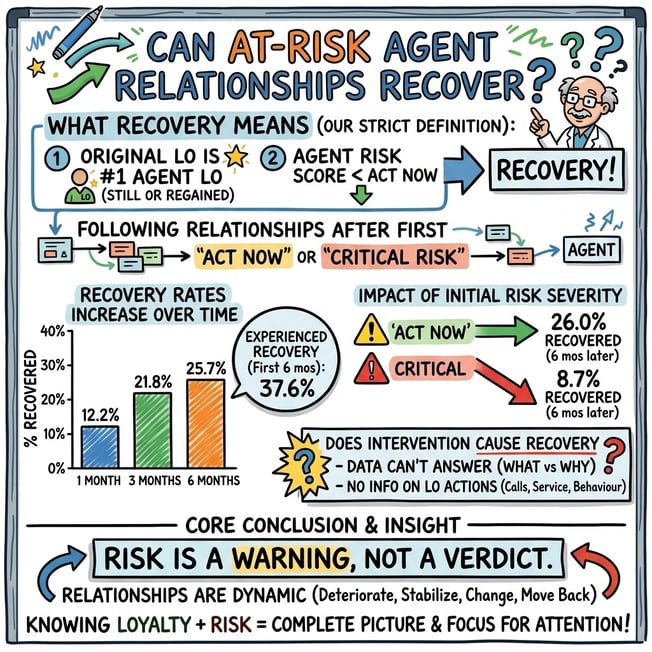
Can an At-Risk Agent Relationship Recover?
Part 4 of our Agent Loyalty & Risk Series
Over the first three parts of this series, we found that high-producing agent relationships change frequently, Agent Risk Scores were strongly associated with what happened next, and elevated Risk often appeared months before another LO took the #1 position.
That left us with one final question:
Once an agent relationship becomes at-risk, is the outcome inevitable?
To find out, we identified the first time an agent moved from below Act Now into either Act Now or Critical Risk.
Then we followed the relationship forward.
What Does “Recovery” Actually Mean?
This requires an important distinction.
A Risk Score can fall because the original LO stabilized the relationship.
But it can also fall because another LO has already taken over the #1 position and the competitive tension has effectively been resolved.
So we used a stricter definition of recovery:
The original LO had to still be—or once again become—the agent's #1 LO, AND the Agent Risk Score had to fall back below Act Now.
Using that definition, recovery absolutely happened.
Among relationships with enough subsequent history:
12.2% had recovered after one month.
21.8% had recovered after three months.
25.7% had recovered at the six-month mark.
And when we asked whether a relationship had experienced at least one period of recovery at any point during those first six months, that number rose to 37.6%.
So an Act Now signal was certainly not a death sentence.
Some LOs Even Regained the #1 Position
There was another interesting group.
By six months, 6.5% of these relationships had lost the #1 position at some point but the original LO had regained it.
In about half of those cases, the original LO was back on top and the Risk Score had fallen below Act Now.
That matters because it shows these relationships aren't necessarily moving in only one direction.
Agent relationships can deteriorate, stabilize, change leaders and, in some cases, move back.
But severity mattered.
Among agents who first crossed into Act Now, about 26.0% met our recovery definition six months later.
Among those who crossed directly into Critical, only 8.7% had recovered six months later.
The deeper the Risk, the harder the road back appears to be.
Does Intervention Cause the Recovery?
We can't answer that from this data.
We don't know whether the LO saw the warning, called the agent, changed their behavior, solved a service issue—or did anything at all.
This analysis shows what happened, not why it happened.
But it does reinforce what may be the most important takeaway from this entire series:
Risk is a warning, not a verdict.
When an important agent relationship begins deteriorating, there may still be a window where the incumbent remains #1 and the relationship ultimately stabilizes.
And that changes the value of the information.
Knowing who your loyal agents are helps you understand the relationships you have today.
Knowing which relationships are becoming risky may help you identify where your attention is needed before the outcome is decided.
That was the idea we wanted to test when we started this series.
After tracking nearly 89,000 high-producing agents across a year of monthly relationship data, the results suggest that knowing both Agent Loyalty and Agent Risk provides a much more complete picture of where an LO's most important agent relationships stand—and where they may be heading.
Upcoming RETR Training
-
- Mon, Sep 21 @ 2p ET - Intro to RETR: The Modern Loan Officer’s Data Advantage Register
- Tues, Sep 22 @ 1p ET - The Complete Borrower Retention Playbook: Refi, Alerts, and Insights in One System Register
Is RETR Better?
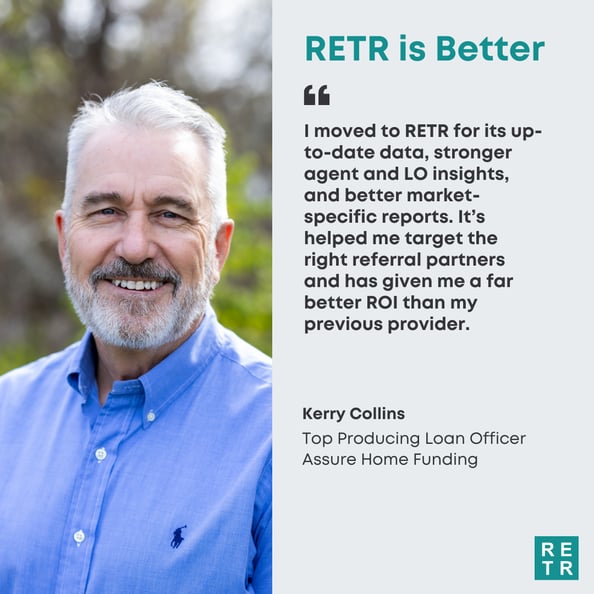
When it comes to mortgage market intelligence, you have a handful of options, and RETR is one that truly stands out. Here’s what Kerry Collins, a top producer at Assure Home Funding has to say about RETR: “I moved to RETR for its up-to-date data, stronger agent and LO insights, and better market-specific reports. It’s helped me target the right referral partners and has given me a far better ROI than my previous provider.”
But you don’t have to take their word for it. RETR offers a free trial to individuals and organizations to judge the quality of the data and insights for themselves.