
Market Movers Last week, 274 originators switched companies and 1,238 individuals obtained their...
Market Movers
Last week, 276 originators switched companies and 1,395 individuals obtained their NMLS license. Notable originator movements last week include:
- Daniel Halvorsen ($140.7M, 373 units) joined NEO Home Loans, powered by Better
- Jane Floyd ($137.1M, 289 units) joined Neighborhood Loans, Inc.
- Sreelakshmi Jasti ($70M, 119 units) joined KEY2NEST HOME LOANS LLC
- Collin Jorden ($68.5M, 167 units) joined Edge Home Finance, LLC
- Nadia Farkas ($56.8M, 104 units) joined Lumin Lending Inc.
- Andrew Towns ($56.5M, 195 units) joined Ease Mortgage
- Jon Kolb ($53.8M, 100 units) joined Ease Mortgage
- Joshua Smith ($53.7M, 193 units) joined K. Hovnanian American Mortgage, L.L.C.
- Keenan Duggan ($50.3M, 155 units) joined New American Funding, LLC
- Joseph Pochron ($50.1M, 125 units) joined CMG Mortgage, Inc.
- Dylan Hoffman ($47.4M, 80 units) joined OriginPoint LLC
- Travis Saling ($47M, 73 units) joined Answer Home Lending, Inc.
- Louisa Lowe ($40.6M, 111 units) joined Three Point Mortgage LLC
- Kyung Jin Hwang ($40M, 38 units) joined Wells Fargo Bank, National Association
- Gregory Cross ($39.3M, 109 units) joined Aspire Mortgage Advisors LLC
Figures are based on last 14 months’ production.
Market Movers (Gainers by Producer Volume)
Top Gainers (non-Bank/CU):
- Aspire Mortgage Advisors LLC +24.8%
- Lumin Lending Inc. +24.76%
- Three Point Mortgage LLC +11.68%
- SayGo Home Loans, LLC +8.82%
- Smart Home Lending LLC +7.22%
- Federal First Lending LLC +6.73%
- Ridgeland Mortgage, LLC +5.81%
- LitFinancial +5.58%
- Pinnacle Mortgage Corporation +5%
- RenoFi +4.76%
- HomeSimply +4.42%
- Ease Mortgage +4.38%
- Summit Lending +4.01%
- Neighborhood Loans, Inc. +3.35%
- MY COMMUNITY MORTGAGE LLC +3.1%
Calculations based on last aggregate production of individual LO’s 14 months’ production. Excludes companies below $100M in 14mo LO production value after gains factored in.
How Long Do Loan Officers Stay After a Mortgage Company Acquisition?
Part 2 of RETR’s Post-Acquisition Loan Officer Attrition Study
The first 90 days get the attention.
The first two years tell the story.
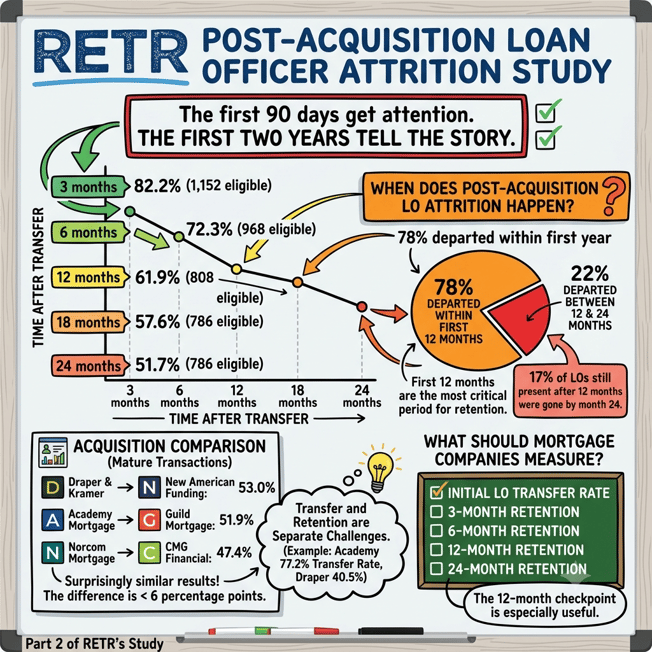
RETR tracked 1,165 Loan Officers who transferred to buyers across eight mortgage acquisitions. Among the transactions with a full two-year observation period, only 51.7% of transferred LOs remained with the buyer after 24 months.
Nearly half were gone.
What is the post-acquisition LO retention rate?
Because the acquisitions occurred at different times, comparing current rosters would make newer transactions look artificially stronger.
Instead, RETR measured retention at consistent checkpoints after each LO transferred:
|
Time after transfer |
Eligible LOs |
Retained by buyer |
|
3 months |
1,152 |
82.2% |
|
6 months |
968 |
72.3% |
|
12 months |
808 |
61.9% |
|
18 months |
786 |
57.6% |
|
24 months |
786 |
51.7% |
The pattern is clear:
About eight in ten transferred LOs remained after three months, six in ten after one year and five in ten after two years.
When does post-acquisition LO attrition happen?
Most departures happen relatively early.
Among the transferred LOs who were gone by the two-year mark, 78% had already left within the first year.
That makes the first 12 months the most critical period for post-acquisition retention.
But measuring only 90-day retention would miss much of the story. Retention continued falling from 82.2% at three months to 61.9% at one year.
By then, acquired LOs have had time to experience the buyer’s technology, operations, compensation, leadership and culture—not just the initial transition.
And attrition does not stop after the first year. Among the mature cohort, 17% of the LOs still present after 12 months were gone by month 24.
Different acquisitions reached similar outcomes
The three transactions with a full two-year history produced surprisingly similar results:
- Draper & Kramer Mortgage → New American Funding: 53.0%
- Academy Mortgage → Guild Mortgage: 51.9%
- Norcom Mortgage → CMG Financial: 47.4%
The difference between the highest and lowest two-year retention rate was fewer than six percentage points.
That is notable because their initial transfer rates were very different.
In Part 1, we found that 77.2% of Academy Mortgage’s roster transferred to Guild, while 40.5% of Draper & Kramer’s roster transferred to New American Funding.
Yet among the LOs who did transfer, their two-year retention rates were nearly identical.
That suggests transfer and retention are separate challenges.
A buyer may convince more LOs to make the initial move without being more successful at keeping them over time.
What should mortgage companies measure after an acquisition?
The number of LOs who join the buyer measures the transition.
It does not measure whether the integration worked.
A more complete acquisition scorecard should track:
- Initial LO transfer rate
- Three-month retention
- Six-month retention
- 12-month retention
- 24-month retention
The 12-month checkpoint may be especially useful. By then, most of the departures observed during the first two years have already occurred.
What does the data suggest?
Acquiring an LO roster is not a single event.
The buyer must first convince LOs to transfer, retain them through the transition and then keep them after the acquisition becomes normal day-to-day employment.
Across the mature transactions in this study, buyers retained approximately:
Eight out of ten transferred LOs after three months
Six out of ten after one year
Five out of ten after two years
The next question is where the other half went.
Did they leave mortgage lending—or did another lender gain the relationships, market knowledge and production potential the buyer lost?
Coming next: Where do acquired Loan Officers go?
Part 3 of RETR’s Post-Acquisition Loan Officer Attrition Study will examine what happened to the LOs who left the buyers—and which mortgage companies gained the most talent.
Upcoming RETR Training
-
- Mon, Aug 3 @ 2p ET - Intro to RETR: The Modern Loan Officer’s Data Advantage Register
- Wed, Aug 5 @ 1p ET - The 3 in 10: Finding & Targeting Loan Officers After an Acquisition Register
Is RETR Better?
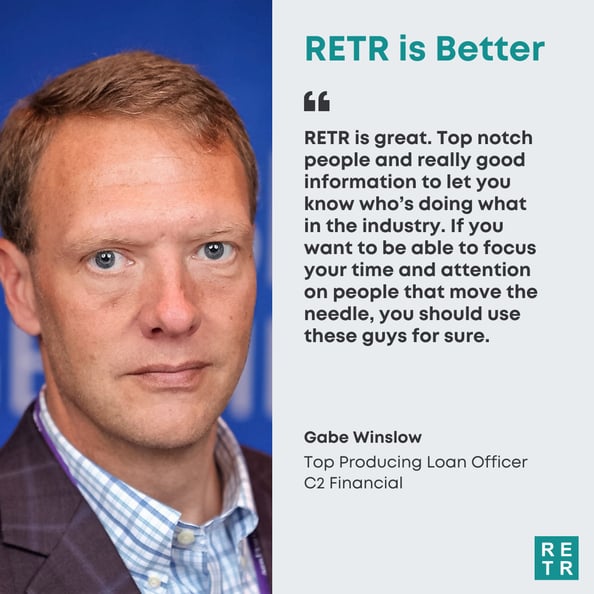
When it comes to mortgage market intelligence, you have a handful of options, and RETR is one that truly stands out. Here’s what Gabe Winslow, top producer at C2 Financial has to say about RETR: “RETR is great. Top notch people and really good information to let you know who’s doing what in the industry. If you want to be able to focus your time and attention on people that move the needle, you should use these guys for sure.”
But you don’t have to take their word for it. RETR offers a free trial to individuals and organizations to judge the quality of the data and insights for themselves.